
Imagine if every day was Thanksgiving, and gratitude was your permanent state of mind.
What would it mean?
I submit it would mean greater levels of wealth, health, and happiness all around.
Here’s why …
To be thankful for something means we appreciate its value. We see the good in that thing. Conversely to be discontented with something means we see the bad and the useless in that thing, and discount its value.
But as the Bard of Avon wrote, “Nothing is good or bad, but thinking makes it so.” These 10 little words are much more than a clever little bit of iambic pentameter. They hold the keys to the kingdom, because the mind attracts that which it thinks about most.
Thoughts are things. An idea held in the mind consistently can’t help but manifest itself in the life of the thinker.
Is this the result of some kind of metaphysical magic?
I prefer to think of it in more practical terms …
John Smith and Jim Brown both work at the same midwestern manufacturing company. Both of them get downsized out of their jobs just two weeks before Thanksgiving.
John is indignant about it. It’s just not fair, he reasons. And although he hated his job anyway, he is very discontented with being unemployed. Fear of remaining so consumes his mind. Opportunities for advancement are all around him, but he can’t see them, because his mental antenna is attuned to joblessness.
Jim Brown on the other hand, sees unemployment as nothing more than an opportunity to spend some time looking for a better way to make a living. And because that’s what he’s looking for, he soon finds it.
Success at anything in life isn’t really much more complicated than that. It’s just mental discipline: training your mind to be appreciative of the things you have and using them as stepping-stones to getting more of what you want. Everything happens for a reason, good, bad, or indifferent.
Regardless, it’s your job to find value in the situation and use it to your advantage.
The Power of Your Mind to Think Independently
Is Your Greatest Gift …
Isn’t it time you threw off the negative social conditioning that’s fooled you into accepting other people’s fears, anxieties, limitations and negative attitudes as your own?
Very few people have the wakefulness to do it. Instead, they sleepwalk through life, complaining about their circumstances, thinking about what they don’t want, and looking for someone to blame. And they’re miserable and unproductive as a result.
The only thing any of us has total power over is the meaning we ascribe to our life experience. Yet how frequently we fail to use that power. Instead we fume, fuss and worry about outcomes we can’t control.
Let me tell you a story that illustrates how powerful the human mind is at filtering experience …
Victor Frankl was a Viennese neurologist and psychiatrist. During WW2 he found himself on a train to Auschwitz, one of the infamous Nazi concentration camps where 6 million people were burned alive in gas ovens.
Upon arrival, he was one of the 5% who were spared immediate incineration. These “lucky” individuals were taken aside and made ready for Nazi work camps in the German interior. Frankl was stripped naked, shaved from head to toe, and the number 119,104 (his new identity) was tattooed on his body.
The following dawn, just before leaving for the camp, he watched his best friend floating up to heaven in a cloud of smoke. Frankl’s wife, whom he’d been separated from earlier in the melee, was also incinerated. Luckily for him, he only found out after the war.
Conditions were so deplorable in the camps that prisoners usually lived for only a few months …
Imagine yourself going through what Frankl did:
- The humiliation of brutal beatings at the hands of the SS guards …
- Having to dig trenches through the frozen topsoil in bitter sub-zero winds wearing nothing but filthy rags and ill-fitting wet shoes … hand-me-downs torn from the corpses of prisoners already succumbed …
- Not being able to sleep for more than a few hours at a time due to the pestering of vermin and lice in overcrowded quarters where men lay packed like sardines on bare wooden floors in their own filth and excrement …
- Subsisting on a cup of watery gruel, 5 ounces of bread, and the occasional slice of poor quality sausage or cheese each day as your body slowly but surely devours itself …
- Watching the living prisoners pilfer the “belongings” of the dead, approaching the still warm corpses to pinch the remains of a messy meal of potatoes, or exchanging shoes with the unfortunate cadaver if they looked like an improvement …
The suffering of the dying and the dead became so commonplace they soon failed to move Frankl, and he joined his fellow prisoners in a kind of emotional death. Disgust, horror, and pity were no longer possible.
What possible “spin” could you put on something like that? How could you possibly look on the bright side of such an experience, where such little hope exists … and where so little possibility of pleasure or escape from pain is possible – save death?
In Frankl’s own words: “The prisoner who had lost faith in the future – his future – was doomed. Without his belief in the future, he lost his spiritual hold: he let himself decline and became subject to mental and physical decay.
Usually this happened quite suddenly, in the form of a crisis, the symptoms of which were familiar to the experienced camp inmates.
It began with the prisoner refusing one morning to get dressed and washed or to go out on the parade grounds. No entreaties, no blow, no threats had any effect. He just lay there, hardly moving. He simply gave up. There he remained, lying in his own excreta, and nothing bothered him anymore.”
How Frankl Survived …
Frankl avoided this fate by finding meaning in his experiences. He imagined himself standing at the podium of a warm and well-lit lecture room, addressing an appreciative audience seated in comfortably upholstered chairs. He was giving a lecture on the psychology of the concentration camp.
He used the power of his mind to become an objective observer, watching the proceedings from the remote viewpoint of science – as though they had already happened.
He, and his troubles, became an interesting psycho-scientific study. Using this “frame” he survived for three long years while hundreds of prisoners – one by one – gave up and died all around him in abject misery.
Now I ask you, if Frankl could turn those lemons into lemonade, what about you? Do you think you can find a way to be grateful for all of the crap in your life? Do you think you might be able to turn it to your advantage?
After the war, Victor Frankl spent 9 days writing the narrative that outlined his findings, and published the book, “Man’s Search For Meaning”. This little one-sitting book has been published in 19 languages, and is now in its 73rd English printing, having sold almost two and a half million copies in English alone.
Frankl’s experiences in the Nazi death camps laid the foundation for a whole new branch of psychotherapy that he developed upon his release. It’s called Logotherapy, and this bold new approach has helped millions of people to lead more meaningful and rewarding lives.
In short, the premise behind Logotherapy is this: Where traditional psychotherapy focuses on the past, attempting to dredge up repressed memories that are causing the patient suffering, and attempting to resolve them, Logotherapy encourages the patient to focus on the meaning of their future life.
What a concept.
Frankl believed man’s search for meaning is his strongest motivation, exceeding all other instinctual and ego-based drives. The big reframe that saved his life was the realization that it doesn’t really matter what we expect from life. What matters is what life expects from us… and that when man finds that it is in his destiny to suffer, he will have to accept his suffering as his task, and be grateful in his ability to find meaning in it.
Victor Frankl died in 1997, at the ripe old age of 92.
Is There a Marketing Lesson Here?
In fact there is. Maslow’s hierarchy of human needs, on which most marketing motivational theory is based, takes a bottom up approach. It says that our motivations are the result of ascension from physiological needs … to safety needs … to love and belonging needs … to self-esteem needs … and finally to self-actualization needs.
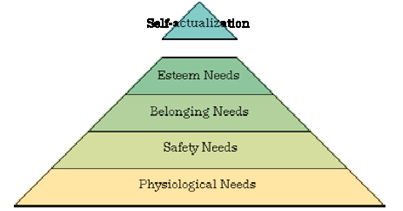
Maslow’s central premise is that human need moves in an orderly procession up the hierarchy. Until a person’s physiological needs (such things as food, water, sleep, the avoidance of pain, etc.) are met, he or she will be unmotivated to pursue safety needs (order, structure, freedom from fear and anxiety, etc.), and even less so for belonging needs (affectionate relationships, friends, social contact) and so on up the hierarchy.
Likewise, once a lower need is largely met, the next one up automatically becomes a dominant motivational force in the person’s life. Obviously, there is some truth in this.
But Frankl’s theory turns the model on its head. He says that man’s primary motivational force is a search for meaning, which corresponds to the self-actualization needs at the very top of Maslow’s pyramid.
Frankl even goes on to say that there exists in society today an existential vacuum – a widespread and growing emptiness in people’s lives, characterized by boredom, and a deep longing to derive more meaning from both work and leisure.
These self-actualization needs are largely overlooked and untapped by most marketers, because it’s assumed that only a small portion of the population can be motivated by them.
Frankl’s research indicates the contrary may be true.
Could It Be That Human Beings Are Searching for Meaning In All the Wrong Places?
Even people who have lost their way are looking for these things… perhaps at the gambling table or at the bottom of a bottle of gin…
After studying his book, I decided to test self-actualization appeals in my sales copy. And I was astounded by what I discovered…
We really are fundamentally motivated by a search for significance and meaning in our lives…
- To contribute to the well-being of those around us…
- To believe that what we are doing with our lives is important, not just to us, but to others, as well…
- Even to be remembered after we’re gone… and to know that our lives meant something and mattered …
When people lack these things in their lives, they descend into despair, loneliness and boredom. They often confuse these symptoms with the disease. And they try to kill the pain in ways that never can.
Most marketers are more than happy to play along. But I know there are great rewards in going deeper.
I know these are not just nice-to-have side benefits to use in your marketing.
I know they are fundamental drivers of human behavior… an invisible undercurrent beneath all other human cravings.
It’s what gives us the indomitable drive and determination to win…
… To build businesses against all odds and to power through strain and adversity.
… To maintain or to take back our health and build a strong mind and able body.
… To love and to care and to tirelessly bring people together and lead them toward a better world.
… To feel pain and fear, and to forge ahead anyway.
… And to live our highest destiny.
What do you think?
Is that what people really want?
Can you really sell to people’s higher nature?
Do you build a better list of subscribers, customers and clients when you do?
Give me your two-cents in the comments box below.
And have a safe, happy, and meaningful Thanksgiving.

Daniel,
What a powerful and inspirational post. I love reading words of wisdom like this because they continue to provide me the drive I need to move forward.
Daniel: You amaze me with your myriad layers of knowledge on so many subjects. Your depth of understanding and ability to describe your message brings to mind the word “wisdom.” Are you 120 years old? If tomorrow I was told that I only could receive emails from one guru, that guru would be Daniel Levis.
Thank you Daniel,
That was great. I have found it always very powerful, when going through the bad stuff to re-frame in the form of a myth — like Orpheus going into the Underworld — that helps not only distance me from the emotional pain, but it actually makes an adventure out of it and allows the situation to give up its riches in terms of depth, maturity and creativity. Then you can bounce back!
As you see, I’m brainstorming my book and your article reinforces the direction in which I was going.
I love you spider analogy as well.
I have know people who have had childhoods that are absolutely horrendous who grow into wise and compassionate adults. Even with their wounds, they decide to care. I have met people who have one little patch of adversity and become mean.
Its amazing!
Have a great Thanksgiving -Canada has one too, I’m sure — on a different day??
Cheers,
Arlene
Hello Daniel,
Thank you for sharing such an amazing and inspirational story with us. I already knew the story of Victor Frankl. It is often used by many inspirational speakers as a reminder that things could always be worse. I agree with this wholeheartedly and when times get tough, I think about people such as Victor Frankl and thank the good lord that I am born in a country “where the deer and the buffalo roam” We don’t realize how blessed we are to be living in a country where we are guaranteed the right to freedom of expression, religion, political views and lifestyle. There are still countries in the world today that are run like giant concentration camps. We need to stop taking things for granted and appreciate our lives a little more. There will always be things to complain about. If, however, we accentuate the positive, this will always get us through the darkest days and back into the light. Thank you for your wonderful literary gift. It is greatly appreciated.
Regards,
Linda
So wonderful and beautifully written! The insights instill not only to my mind but to the soul.I absolutely agree with you that we need to appreciate everything for it has its own purpose and meaning of existing. I love reading the article.Thank you for inspiring me and to all the re
aders.
Have a blessed day ahead!
herne
I am an avid reader of yours and I always find your articles very inspirational, thought provoking and witty – well crafted out from experience, exposure and wisdom.
I enjoyed the “9 Forbidden Keys” article a lot that I devoured it in a very few minutes. Thank you so much that was very fancy gift. I hope to be able to apply them on my own endeavors and I am certain, they would greatly help.
Happy Thanks giving and God bless to you.
Daniel, Thank you so much. I am so glad I’m not alone on this journey, so often think how does one break down the barriers folks have put up. The homily Wed. evening was about gratitude…we do have so much to be grateful for, we must look inside not out. Thank you for sharing these thoughts with us. Blessings, Elodie Winger
Mr. Daniel Levis – There is a small book measuring 2 3/4″ x 31/4″that has been residing in the breast pocket of my shirt for over 20 years. This version of “As A Man Thinketh” by James Allen was the second printing in 1989. My little volume has 87 pages which I read through every New Years Day.
“The Prophet” by Kahlil Gibran, “Atlas Shrugged” by Ayn Rand, and “The True Believer” by Eric Hoffer, are all well worth your attention.
The off spring of your muse will now become dominant in my library.
The always beneficial to understand tips familiar discuss for web log advertisment. When I just rolling publishing opinions for weblog and facing difficulty of a bunch of rejections. I believe your advice is going to be of great help for me. I’m able to tell you if its improve me too.
You truly make it look so easy with your presentation but I find that topic being really something that I think I would by no means understand. It seems too complicated and incredibly broad for me. Im looking forward for your following post, I will try to get the hang of it!
Hi really liked that post, thank you.
At the same thing I never made the link between the Maslow hierarchy and the advertising iindustry. It really put things in perspective for the way I will market to my audience. So what I see his that Self-actualization speak to the hearth and the bottom human needs speak to the mind… witch his fear based most of the time…
Your peptalk is always on point and doesnt sound corny to my ear and I like that.
Here`s something I found on the web and I wanted to share
Abraham Maslow’s 8 Ways to Self-Actualize
1. Experience things fully, vividly, selflessly. Throw yourself into the experiencing of something: concentrate on it fully, let it totally absorb you
2. Life is an ongoing process of choosing between safety (out of fear and need for defense) and risk (for the sake of progress and growth): Make the growth choice a dozen times a day.
3. Let the self emerge. Try to shut out the external clues as to what you should think, feel, say, and so on, and let your experience enable you to say what you truly feel.
4. When in doubt, be honest. If you look into yourself and are honest, you will also take responsibility. Taking responsibility is self-actualizing.
5. Listen to your own tastes. Be prepared to be unpopular.
6. Use your intelligence, work to do well the things you want to do, no matter how insignificant they seem to be.
7. Make peak experiencing more likely: get rid of illusions and false notions. Learn what you are good at and what your potentialities are not.
8. Find out who you are, what you are, what you like and don’t like, what is good and what is bad for you, where you are going, what your mission is. Opening yourself up to yourself in this way means identifying defenses – and then finding the courage to give them up.
I love this post!
I’m very familiar with Frankl’s story, and to hear him speak is amazing. There’s an ‘old jewish lady’ with a similar story interviewed by Tony Robbins.
Maslow’s model vs. Frankl’s is a no-brainer, in my experience. Otherwise there’d be mass suicide in the ‘developing world’ as almost no one has Maslow’s *physical needs* met, but from what I can tell… it’s not hard to discover that on the whole… they have families/friends of some kind, they show love, and they assign meaning to their lives and experiences.
Fantastic post, Daniel, I fully encourage this.
I believe that the thoughts you expressed go beyond marketing, at least marketing as I understand it. I’m in the health niche, and motivating people to take better care of themselves isn’t easy! This could be the answer. Thank you for your time taken to write this inspiring piece.
There’s definately a search for providing lasting value when building an email list. Being able to provide value through a blog post like this one Daniel, makes me feel humbled and appreciate the value within it.
Another awesome, insightful post. Thanks for sharin’ it.
Thanks for the feedback guys, I’m glad you enjoyed this post.
Thank you I do my best to reread your emails! More Enlightening. Daniel.
Daniel,
Thank your for this excellent post!
Being a prisoner in a German Death Camp, Frankl realizes that looking at his world from a purely physical perspective leads to despair.
However we human beings are not purely physical, but as Frankl’s tradition teaches, we are made in the image of God. And therefore our alternatives are unlimited if we apply our greatest power, the power of thought.
Fortunately, we don’t have to suffer the evil that was imposed on Frankl and the others who were in the Death camps to realize this important truth about intentionally living well.
Alan
Thank you for sharing this inspiring post. All these years we assumed the Maslow’s pyramid as a given and a step-by-step progression of needs.
What you say in this post makes sense. Even those fighting to meet their most basic needs (physiological needs) would like to believe they matter. If not to the world, but at least to those near and dear ones.
Thank you, Daniel.
This is a wonderful adjunct to the book I’m currently reading (actually listening to) for the second time – Ben Hardy/Dan Sullivan’s “The Gap and the Tain”. You may be familiar with the concept – “gap-thinking” keeps people unhappy, always fretting about what they haven’t done or gotten. “gain-thinking” is celebrating what you have, how much you’re advanced from a former time (a month, a year, or 20 years ago). If you haven’t exactly achieved what your former self set out to do, you’re still celebrating wins and looking forward to more gains – specific, not idealistic.
The concept you speak of is a wonderful extension of gain-thinking.
Thank you.